
As information and communication capacity continues to increase, multichannel interconnection has become an important trend in optical interconnect technology.
Compared with single channel connections, multichannel connections require high precision alignment (for example, core alignment), which creates challenges in work efficiency.
At Orbray, as one approach to addressing this challenge, we are developing the Light Induced Self Written Optical Waveguide (LISW WG).
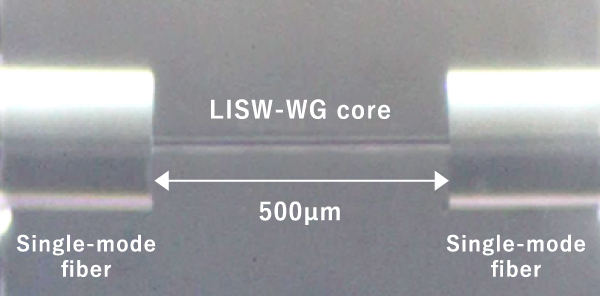
LISW WG between single mode fibers
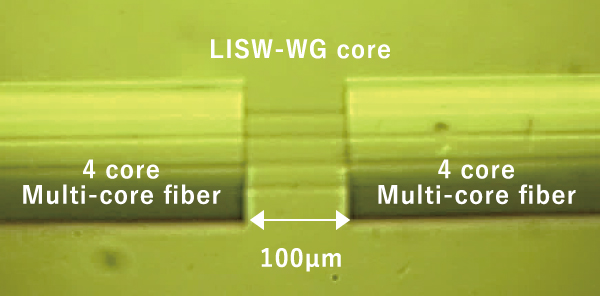
LISW WG between four core multicore fibers
Features of the LISW WG
The LISW WG is a technology that forms an optical waveguide by transmitting a photocurable resin with laser light, enabling optical coupling between optical components or optical waveguides. Because it does not require active alignment, it enables simple, low loss coupling to optical fibers and waveguides.
1. Reduced alignment liability in optical coupling
By forming a waveguide through laser light emitted directly from an optical fiber, low loss coupling is possible even between misaligned fibers.
2. Enables simultaneous multichannel connection
Multiple channels can be connected simultaneously. In high density packaging, this capability is expected to significantly reduce connection time.
3. Enables coupling between fibers (waveguides) with different core diameters
Even when the core diameters of the fibers to be connected differ, coupling using the LISW WG is possible. This provides an effect like that of a spot size converter.
Fabrication Method of the LISW WG
For effective light propagation, the refractive index difference between the core and the cladding is a critical parameter. In conventional optical waveguide fabrication, this typically requires two materials with different refractive indices. However, replacing materials increases fabrication time.
Orbray has succeeded in creating the refractive index difference between the core and cladding using a single material, based on an original material design and fabrication method. The process consists of two steps: STEP 1: Core Formation and STEP 2: Cladding Formation.
STEP 1: Core Formation
Optical fibers (optical waveguides) are positioned face to face in a photocurable resin, with a gap between them where the LISW WG will be formed. Light at a wavelength capable of curing the resin is transmitted from both fibers. The resin cures along the optical path, forming the core of the LISW WG.
STEP 2: Cladding Formation
After forming the core, light is transmitted again from the optical fiber to form the cladding of the LISW WG. The cladding is created using light that leaks from the core.
This cladding formation process minimizes stress on the core caused by curing shrinkage, resulting in a LISW WG with low insertion loss.
Orbray’s LISW-WG fabrication method
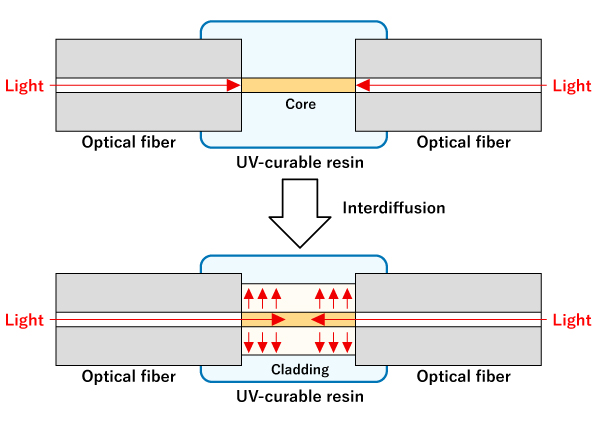
Cladding is formed using light that leaks from the LISW-WG core.
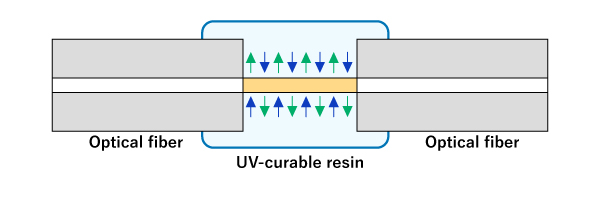
When light transmission is stopped, a concentration difference occurs in the chemical reaction rates between monomers. Monomer diffusion occurs to eliminate the temperature difference.
Opt.Laser Technol., vol. 175 Aug.2024,110786.
https://dx.doi.org/10.1016/j.optlastec.2024.110786
Examples of LISW WG Applications
To support a wide range of coupling types, two materials have been developed: a UV curable resin and a near infrared (NIR) light curable resin.
- With the UV curable resin, LISW WG coupling between standard optical fibers is possible.
- With the NIR light curable resin, applications such as coupling between an optical fiber and a silicon optical waveguide, or between an optical fiber and a light source, are envisioned.
Coupling Examples Using UV Curable Resin
Coupling between single mode fibers
LISW-WG coupling between single-mode fibers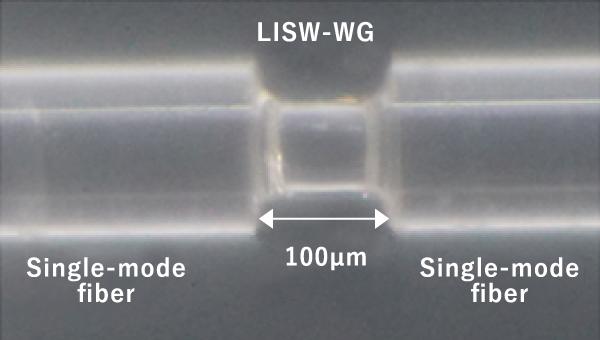
Insertion loss: 0.24dB@1550nm、0.29dB@1310nm
Return loss: 38.2dB@1550nm、41.7dB@1310nm
Spot size converter using the LISW WG
LISW WG coupling between a single mode fiber and a high NA fiber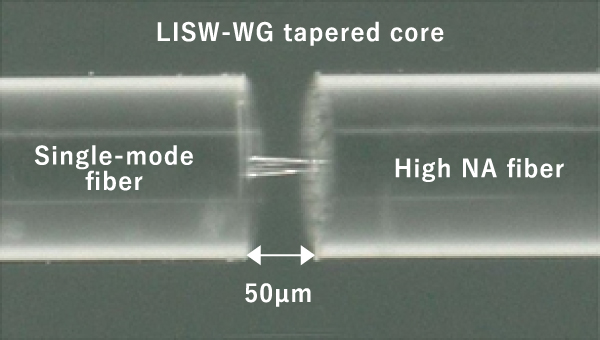
Insertion loss:0.7dB@1550nm
Fabrication of a fan out device (Coupling between a multicore fiber and a bundle fiber)
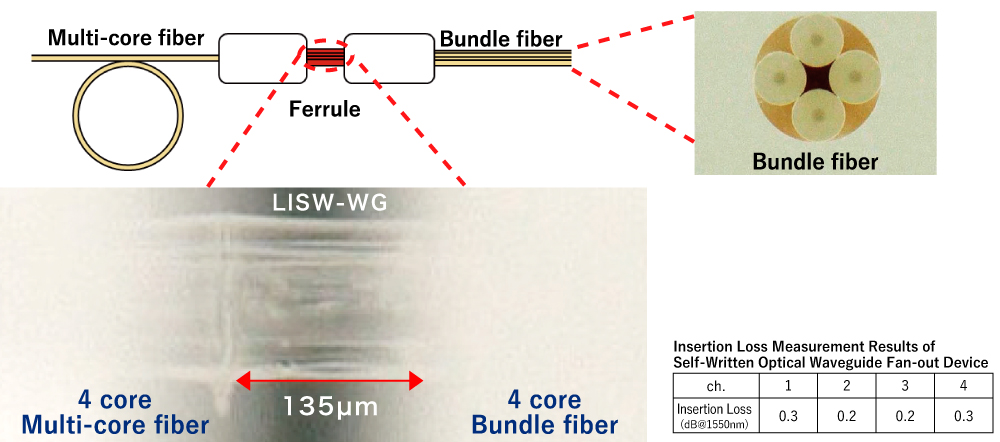
Coupling example using NIR light curable resin
Coupling between a single mode fiber and a silicon optical waveguide
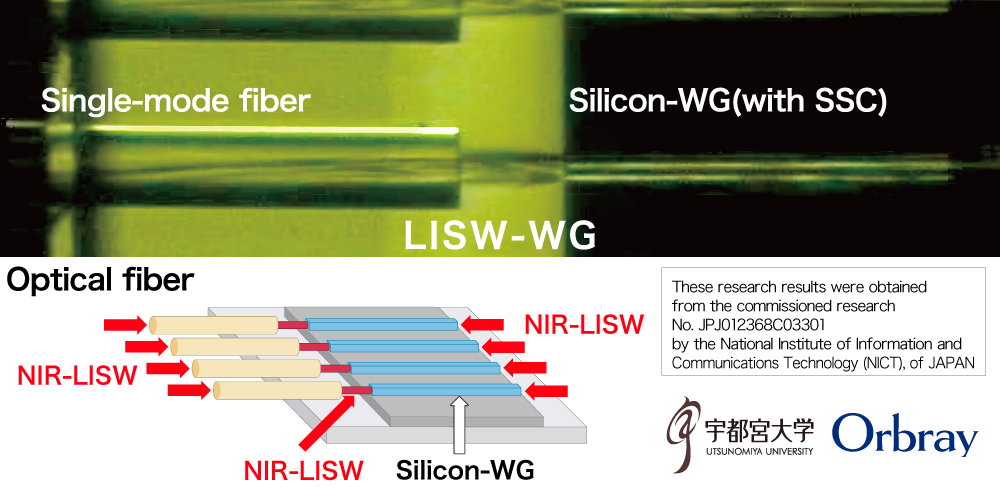

Mon-Fri 9:00-17:00 JST+81-3-3919-1171

Online Contact