
Differences Between Brushed and Brushless Motors
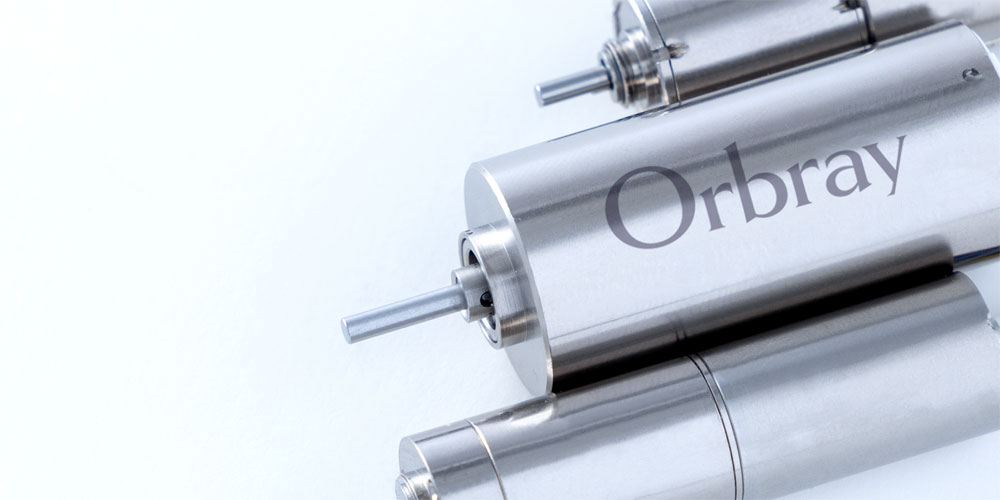
Although both brushed and brushless motors belong to the DC motor family, their performance characteristics and ideal applications are quite different. To choose the right motor, it is important to understand these differences.
The primary difference these motors is the presence or absence of mechanical contacts such as brushes and a commutator. This structural variation has a significant impact on motor efficiency, lifespan, and cost.
This article focuses on the key distinctions between brushed and brushless motors, along with guidance on selecting the best option for your application.
For detailed explanations of their structures and operating principles, please refer to the following articles.
What Is a Brushless DC Motor(BLDC motors)? Understanding Its Structure, Operating Principle, and ApplicationsWhat Is a Brushed Motor? Understanding Its Features and Brush Materials
Table of contents [close]
Differences Between Brushed and Brushless Motors
The fundamental difference between brushed and brushless motors lies in how commutation, the switching of current direction, is performed.
Brushed motors use mechanical commutation through contact between brushes and a commutator, while brushless motors use electronic circuitry to switch current direction.
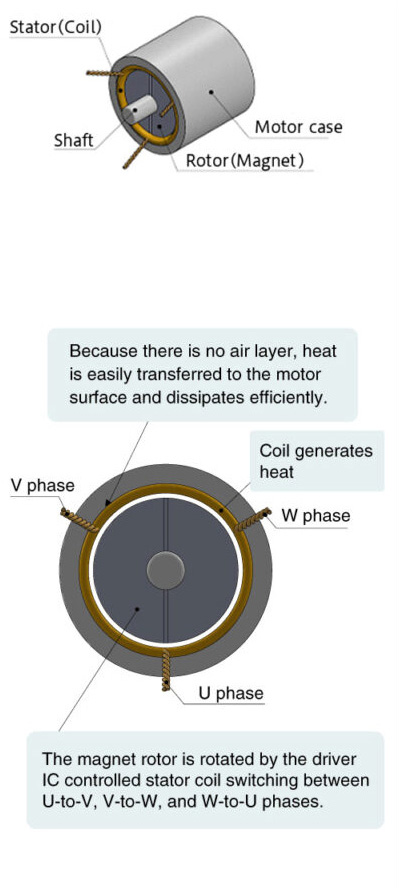
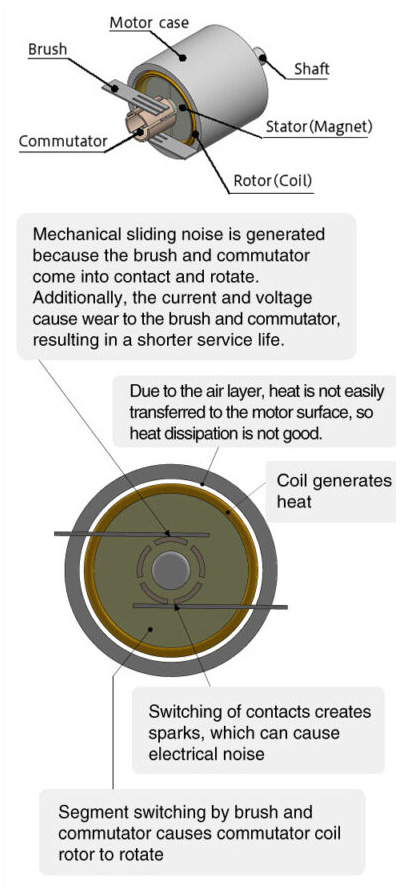
As a result, these two motor types differ in the following five aspects:
- Efficiency
- Lifespan
- Heat dissipation
- Noise and electrical interference
- Cost
Efficiency
Brushless motors generally offer higher efficiency than brushed motors.
In a brushed motor, commutation occurs through physical contact between the brushes and commutator. Because these components remain in contact while rotating, friction generates heat. Electrical resistance at the contact points and sparking during commutation also consume energy.
A brushless motor, on the other hand, uses electronic commutation and therefore has no rubbing contacts. Since the rotating part does not contain heat-generating windings, power loss is reduced resulting in higher efficiency.
Lifespan
Brushless motors also typically have a longer service life.
The brushes and commutator in a brushed motor are wear components that continuously rub against each other during operation. Their deterioration is caused by both mechanical wear and electrical erosion due to sparking.
In motors where brushes cannot be replaced, the entire motor may need replacement when these components wear out. Depending on operating conditions, the expected lifespan generally ranges from several hundred to several thousand hours.
Brushless motors eliminate these sliding contacts entirely. Their lifespan is primarily determined by bearing durability, and under suitable conditions they can operate reliably for tens of thousands of hours.
Heat Dissipation
Brushless motors have an advantage in terms of heat dissipation as well.
In brushed motors, the windings that generate heat are located on the rotor. Because an air gap separates the rotating windings from the motor housing, heat transfer to the outside is less efficient.
In contrast, brushless motors place the windings on the stationary stator, allowing heat to dissipate more effectively.
This difference also affects power capability. In brushed motors, high current can damage the contact points, limiting the amount of power that can be supplied. Brushless motors have no such contacts, making them better suited for high-current, high-output applications.
Noise and Electrical Interference
Brushless motors generally produce less noise and electrical interference.
Brushed motors generate sliding noise from contact between the brushes and commutator. In addition, sparks produced during commutation can create electrical noise.
Because brushless motors have no physical contact points, they avoid these sources of noise. However, brushless motors may still generate switching noise from electronic control circuits, as well as vibration and operational noise related to their design.
Cost
Unlike the factors above, when it comes to cost, brushed motors are generally more cost-effective.
Brushed motors have a simple structure with fewer components and do not require dedicated electronic drive circuits. They can operate directly from a DC power source, resulting in lower system costs.
Brushless motors deliver superior performance but require drive electronics and rotor position detection mechanisms, making them more expensive. In other words, performance and cost often involve a trade-off. When selecting a motor, it is important to balance performance requirements against budget constraints.
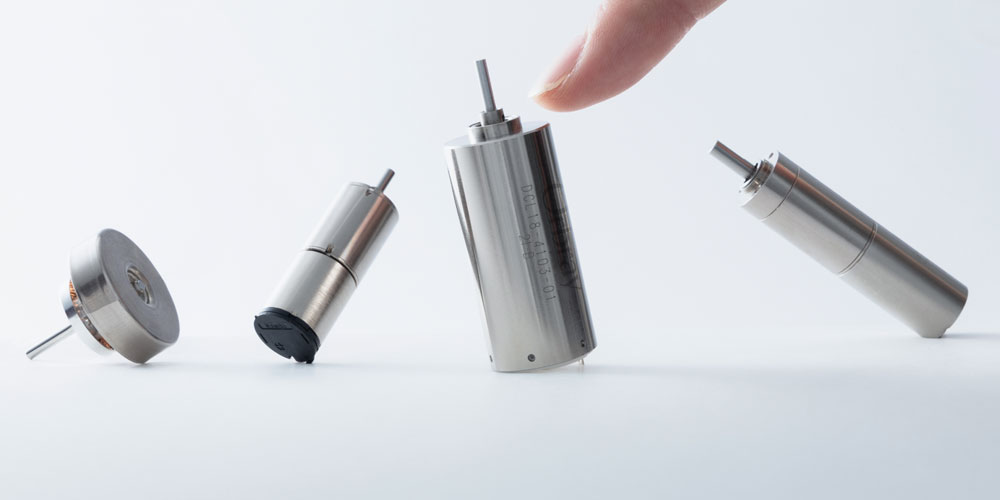
Application Differences Between Brushed and Brushless Motors
The characteristics discussed above naturally lead to different application areas for each motor type.
In practice, motors are used across a wide range of industries, including medical devices, precision equipment, semiconductor manufacturing systems, and robotics. Selection depends on the specific performance requirements of each application.
Note: The brushed-motor evaluations in the application comparison below reflect the characteristics of Orbray’s coreless brushed motors. In coreless designs, the rotor consists of an ironless coil, resulting in low rotor mass, low inertia, and excellent responsiveness. Conventional cored brushed motors, in which coils are wound around an iron core, may differ in rotor weight, inertia, heat dissipation, and other characteristics. Please review the motor structure and specifications when selecting a motor for a specific application.【Legend】
◎:Optimal (delivers the best performance)
○:Suitable
△:Usable but not optimal
Medical devices
| Application | Brushed Motor |
Brushless Motor |
Key Selection Criteria |
|---|---|---|---|
| Anesthetic devices | 〇 | ◎ | Quiet and consistent operation are critical. Brushless motors provide consistent, silent operation with no cogging. |
| Endoscopes | 〇 | ◎ | Smooth and precise movements free of vibrations are required. Quality and safety are critical. |
| Drug delivery pumps | ◎ | 〇 | Lightweight, compact size, and low power consumption are critical, especially for battery powered pumps. Precise control based on feedback is also important. |
| Dental handpieces | 〇 | ◎ | High rotational speed, low vibration, and durability directly impact patient comfort and precision of dental work. |
| Medical pumps | ◎ | 〇 | Consistent flow rate, low noise, and high reliability are essential for life-sustaining devices such as dialysis systems. |
Precision instruments and measuring devices
| Application | Brushed Motor |
Brushless Motor |
Key Selection Criteria |
|---|---|---|---|
| Telescopes | △ | ◎ | Precise movement, compact size, and positioning accuracy are essential for astronomical observations. |
| Measuring devices | ◎ | 〇 | Consistent operation at set speed and smooth movement are critical. High responsiveness is required. |
| Microscope stages | △ | ◎ | Precise positioning, suppression of vibrations, and stability at low speeds are essential for accuracy in research and survey settings. |
| Analyzers | 〇 | ◎ | Precise speed control, long-term stability, and low heat generation are required to ensure repeatability. |
| Optical focus mechanisms | 〇 | ◎ | Precise positioning and minimal backlash are required. |
Semiconductor manufacturing devices
| Application | Brushed Motor |
Brushless Motor |
Key Selection Criteria |
|---|---|---|---|
| Mounter heads | △ | ◎ | Small size, precise positioning, and compatibility with hollow shafts are required. Semiconductor manufacturing requires precise movements done very quickly. |
| Tape feeders | ◎ | 〇 | Thin design and precise positioning are required. Demand for flat motors is increasing. |
| Wafer delivery robots | △ | ◎ | Precise positioning, compliance with cleanroom requirements, and minimal particle generation are required. Direct link to manufacturing yield. |
| Inspection equipment | 〇 | ◎ | High-speed, high-accuracy operation with long-term stability is critical for quality assurance. |
Robotics
| Application | Brushed Motor |
Brushless Motor |
Key Selection Criteria |
|---|---|---|---|
| Robotic hands | △ | ◎ | Multiple degrees of freedom, compact size, high power output, and passive holding ability are important features. Compact size is especially important as the drive mechanism must fit inside the limited space available in moving joints. |
| Communication robots | △ | ◎ | Long operation time, high torque, and quiet operation are essential. Quietness is especially important because these robots are designed to communicate with people. |
| End effectors | △ | ◎ | Compact size, high power output, high efficiency, and heat suppression are critical. Efficiency is particularly important to address heat buildup during gripping tasks. |
| Collaborative robot joints | 〇 | ◎ | High torque density, precise control, and safety are essential. These factors ensure the flexibility and safety required for collaborative work with humans. |
Video and broadcasting equipment
| Application | Brushed Motor |
Brushless Motor |
Key Selection Criteria |
|---|---|---|---|
| Drone gimbals | △ | ◎ | Light weight and responsive control are essential. Instantaneous reaction to camera motion and multi-axis stabilization are required. |
| Broadcast camera lenses | ◎ | 〇 | High responsiveness, quiet operation, and low-voltage operation are desired. Operation must be quiet to avoid motor noise being captured in the recording. |
| Camera autofocus | ◎ | 〇 | Fast response, low power consumption, and quiet operation are essential as these factors directly affect the quality of the photographing experience. |
| Professional projectors | 〇 | ◎ | Long service life, silent operation, and consistent performance are required. Must support long-term use. |
Security and industrial equipment
| Application | Brushed Motor |
Brushless Motor |
Key Selection Criteria |
|---|---|---|---|
| Electronic locks | ◎ | △ | Good responsiveness, tolerance to high and low temperatures, and long operational life are critical. Must be durable across high number of lock/unlock cycles. |
| Security cameras | ◎ | △ | Long life, tolerance to low temperatures and good responsiveness are critical. Must be highly reliable as operation is 24/7. |
| Pan/tilt mechanisms for security cameras | 〇 | ◎ | Precise positioning, quiet operation, and weather resistance are required—especially for outdoor installations. |
Office and household devices
| Application | Brushed Motor |
Brushless Motor |
Key Selection Criteria |
|---|---|---|---|
| Air purifier fans | 〇 | ◎ | Quiet, efficient, and long-term operation. Must support 24/7 operation. |
Hobby and leisure
| Application | Brushed Motor |
Brushless Motor |
Key Selection Criteria |
|---|---|---|---|
| Radio control (RC) | 〇 | ◎ | Good responsiveness and high torque are desired. Ultra-fast response (under 15 ms) is often required. |
| Electric fishing reels | 〇 | ◎ | High torque, water resistance, and battery efficiency are critical for extended outdoor use. |
Personal care and specialty devices
| Application | Brushed Motor |
Brushless Motor |
Key Selection Criteria |
|---|---|---|---|
| Dust mask fans | ◎ | △ | Good responsiveness, low power consumption, and low-profile design are critical. Operation must synchronize with the user’s breathing pattern. |
| Tattoo machines | ◎ | 〇 | High speed rotation and low vibration are critical. Vibration suppression is essential to reduce operator fatigue. |
Let's take a closer look at where each motor type excels.
Applications Suitable for Brushed Motors
- Cost-sensitive applications:
No drive circuit or position sensor is required, resulting in fewer components and simpler system design. - Applications requiring simple control:
The motor can run directly from a DC power supply without electronic commutation. - Battery-powered portable devices: The lightweight rotor structure allows operation with relatively low power consumption.
- Applications requiring frequent starts and stops: The lightweight rotor has low inertia, enabling rapid acceleration and deceleration.
Their simple construction and ease of operation are major advantages. Small brushed motors operating at low voltage are particularly suitable for portable devices where size, weight, and cost are important considerations.
Applications Suitable for Brushless Motors
Brushless motors are ideal for equipment requiring long service life, quiet operation, and high efficiency.
- Long-life applications:
No wear-prone contact points; lifespan is largely determined by bearing durability. - Low-noise applications:
No brush-to-commutator contact means no friction noise or sparking noise. - High-precision positioning applications:
Electronic commutation enables precise current control and reduced torque ripple. - High-efficiency and low-heat applications:
No voltage loss at contact points, and stator-mounted windings improve heat dissipation. - High-speed applications:
No mechanical brush limitations, making high rotational speeds possible without increased wear or sparking.
Their high efficiency, excellent thermal performance, and ability to operate at high speeds make them suitable for demanding applications. Since they have no wear-prone contacts, they also require less maintenance while providing stable, long-term operation.
Key Factors to Consider When Selecting a Motor
Motor selection should begin with a clear understanding of the application's requirements.
The following factors should be evaluated:
- Size and weight
- Output power and efficiency
- Control complexity
- Operating environment (temperature, humidity, vibration, etc.)
- Total cost, including long-term operating expenses
- Reliability and service life
The most important point is not which motor is inherently better, but which is better suited to the application. For example, brushless motors are often preferred for long-term continuous operation, while brushed motors are attractive for simple, cost-sensitive mechanisms.
Orbray offers both coreless brushed motors and slotless brushless motors, allowing customers to select the optimal solution based on their specific requirements.
For more information, please visit:
Brushed Motors Brushless MotorsConclusion: Choose the Right Motor for Your Application
Brushed and brushless motors differ fundamentally in the way commutation is performed. Brushed motors use mechanical commutation through physical contacts, while brushless motors use electronic commutation. This distinction leads to differences in efficiency, lifespan, heat dissipation, noise characteristics, and overall performance.
Brushless motors generally excel in efficiency, durability, thermal performance, and low-noise operation, while brushed motors maintain a cost advantage. Rather than viewing one as universally superior, it is more accurate to recognize that each has strengths suited to different applications.
Orbray manufactures both coreless brushed motors and slotless brushless motors.
Our brushed motors feature outstanding responsiveness enabled by lightweight coreless coils, and low electrical noise thanks to precious metal brush contacts. Our brushless motors provide smooth, cogging-free rotation, excellent responsiveness, long service life, high torque, and high output capability.
We can recommend the optimal motor solution based on your performance requirements and application needs. Please feel free to contact us for assistance with motor selection.
Brushed Motors Brushless Motors