What Is a Brushed Motor? Understanding Its Features and Brush Materials
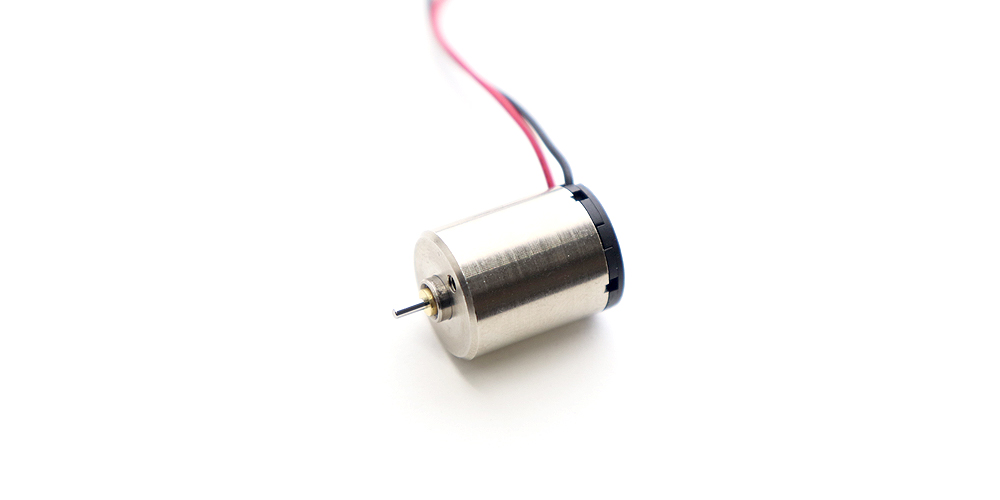
Many devices we use in everyday life are powered by motors. Among them, brushed motors are one of the most fundamental motor types and have been used for many years in a wide range of products, including toys, household appliances, and electrical automotive components.
Because they can operate simply by being connected to a DC power supply, brushed motors are often regarded as one of the most common and familiar motor types. However, details about their structure and operating principles, as well as the differences between brush materials, may be less commonly known.
This article explains the basic structure and operating principles of brushed motors, how they differ from brushless motors, and how the materials used for brushes influence performance.
Table of contents [close]
What Is a Brushed Motor?
A brushed motor rotates by mechanically switching the direction of current using brushes and a commutator. A motor of this type that operates on direct current is known as a brushed DC motor .
Compared with a brushless DC motor, which replaces the brushes and commutator with electronic circuitry, a brushed motor represents the original form of DC motor technology. Thanks to its long history and simple construction, it continues to be used in a wide variety of equipment today.
One of its greatest advantages is its simplicity. The motor can operate simply by connecting it to a DC power source. However, the brushes and commutator are subject to wear, making periodic maintenance necessary.
Basic Structure of a Brushed Motor
A brushed motor consists of four main components: a stator, a rotor, a commutator, and brushes.
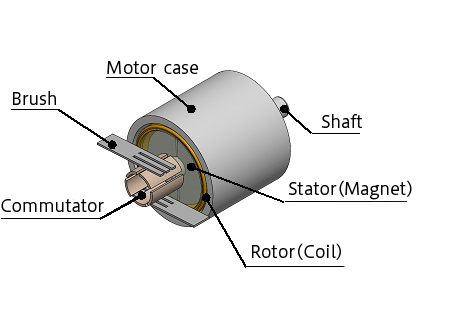
In both cored and coreless motor designs, the roles of the stator and rotor remain the same regardless of which is equipped with the magnet and which is equipped with the coil. However, the inner-outer positional relationship between the magnet and coil is reversed between cored motors, where coils are wound around an iron core, and coreless motors, which have no core.
In a typical cored type, the permanent magnets are placed on the outer stator, while the armature (the rotor consisting of coils wound around an iron core) rotates inside.
Note: The figure above shows the coreless structure used by Orbray, which employs a cup-shaped, self-supporting coil. In a coreless motor, the positional relationship of the components is reversed: the cup-shaped coil (rotor) rotates around a centrally fixed permanent magnet (stator).
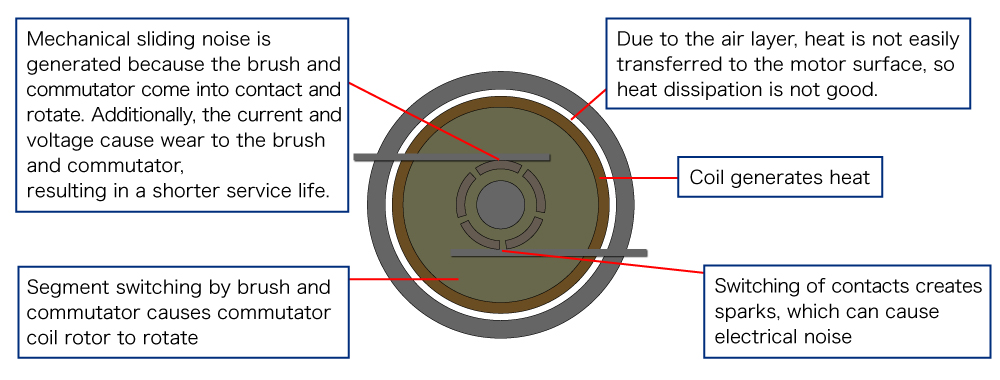
In either configuration,both ends of the coils are connected to the commutator, an electrode that rotates together with the rotor. Current is supplied to the commutator from the power source via the brushes. These stationary brushes are connected to the power source, and conduct electricity while in contact with the rotating commutator.
Orbray's brushed motors feature a coreless design without an iron core, enabling compact size and excellent responsiveness.
How a Brushed Motor Rotates
A brushed motor rotates by continuously switching the direction of current flowing through the coils. This switching function is performed by the brushes and commutator.
First, current flows from the brushes through the commutator and into the coils. As it flows through the magnetic field generated by the stator, an electromagnetic force is produced on the coils causing the rotor to begin rotating. After approximately half a revolution, the commutator segments in contact with the brushes change, reversing the direction of current in the coils.
This reversal also changes the direction of the force acting on the coil, allowing the rotor to continue rotating in the same direction. In brushed motors, this process of switching current direction, known as commutation, is achieved through mechanical contact. Reversing the polarity of the power supply changes the rotation direction, while adjusting the applied voltage controls the rotational speed.
What Is the Difference Between Brushless Motors and Brushed Motors?
The biggest difference between brushed and brushless motors lies in the method of commutation. Brushed motors mechanically switch current using brushes and a commutator, whereas brushless motors switch current electronically through a drive circuit.
They also differ in service life, efficiency, and cost. For a more detailed comparison, please refer to our related article, "Differences Between Brushed Motors and Brushless motors"
Differences Between Brushed and Brushless Motors
Brush Materials Used in Brushed Motors
Because brushes maintain electrical contact while rubbing against the commutator, the material used for the brush has a significant impact on motor characteristics. Two common materials used are metal and carbon, each suited to different applications.
Metal Brushes
Metal brushes are a general category of brushes made from metallic materials. Some low-cost versions use flat spring contacts, but precious-metal brushes are commonly used in miniature, precision motors. These brushes use alloys containing precious metals such as gold or silver for the contact points and are particularly suitable for small, low-power motors operating at low voltages and currents.
Because the contact resistance is low and stable, electrical conduction is smooth and electrical noise is minimized. This makes precious-metal brushes ideal for applications requiring quiet operation and high precision. However, while these contacts offer excellent resistance to electrical corrosion, they tend to be more susceptible to physical wear. Brush life can vary considerably depending on operating conditions.
Carbon Brushes
Carbon brushes use carbon as the contact material that slides against the commutator. Because they offer excellent wear resistance and can handle high currents, they are widely used in high-output motors found in vacuum cleaners, power tools, automotive power windows, and other applications requiring significant power.
Carbon brushes can be broadly divided into two types. One is the graphite type, which is made entirely of graphite. While it generates fewer sparks, it tends to exhibit a greater voltage drop across the commutator. The other is the metal-graphite type, which contains graphite mixed with metal powders such as copper or iron. This type offers higher electrical conductivity and can handle larger currents, making it a common choice for small DC motors.
In general, graphite brushes are preferred for applications where minimizing sparking is important, while metal-graphite brushes are often selected for applications requiring stable high-current operation. However, if spark suppression and noise reduction are the highest priorities, graphite brushes may still be chosen despite their higher voltage drop. Ultimately, the most suitable brush type depends on the specific requirements of the application.
Both types of carbon brushes offer excellent durability. However, compared with precious-metal brushes, they tend to generate larger sparks and more electrical noise.
Orbray offers the CMC12-22xx series in our range of coreless motors. This series features metal-graphite carbon brushes, which are capable of handling higher current levels. While precious-metal brushes tend to wear more quickly and often have a shorter service life in high-load applications, carbon brushes are more resistant to wear and can achieve longer operating life under similar high-output conditions. By leveraging the high-current capability and durability of carbon brushes, the CMC12-22xx series is designed for applications that require both power and long service life.
Key Features of Brushed Motors
The main characteristics of brushed motors are as follows:
- Simple structure contributes to ease of use
- Performance varies depending on brush material
- Regular maintenance is required due to wear
Simple Structure and Ease of Use
One of the greatest advantages of brushed motors is their simple construction and easy-to-understand operating principles. Small models can even run on a dry-cell battery, and they do not require complex control systems.
Their ease of use is also reflected in their control method. Increasing or decreasing the supply voltage changes the rotational speed, while reversing the polarity of the power supply reverses the direction of rotation. As a result, basic control can be achieved using nothing more than simple wiring and switches.
However, if precise speed control is required, a dedicated drive circuit becomes necessary. In practice, brushed motors are often combined with control circuitry based on the needs of the application.
Performance Depends on Brush Material
Different brush materials give brushed motors different strengths. Even within the same category of brushed motors, performance characteristics can vary significantly depending on the contact material used.
Precious-metal brushes offer low electrical noise and stable operation even at low current levels, making them suitable for precision equipment where quiet operation and accuracy are important.
Carbon brushes, on the other hand, are highly resistant to wear and capable of carrying large currents. This makes them well suited for power tools, household appliances, and other equipment that requires substantial power.
Maintenance Is Required Due to Wear
Because brushed motors operate with the brushes and commutator in constant physical contact, these components gradually wear over time. Wear occurs in two forms: physical wear caused by friction between contact surfaces, and electrical erosion caused by sparking during operation. Both can reduce performance, making periodic inspection and replacement essential.
Compared with brushless motors, which do not have wearing electrical contacts, brushed motors are generally at a disadvantage in terms of service life. The commutator also wears over time, and depending on the design, replacement of the entire motor may eventually be necessary.
Conclusion: Brush Material Has a Major Impact on Brushed Motor Performance
A brushed motor is a simple motor that rotates by switching current through brushes and a commutator. While it offers the convenience of operating directly from a DC power supply, maintenance due to brush wear remains one of its primary drawbacks.
Another important factor is that the characteristics of a brushed motor vary depending on the brush material used.
Precious-metal brushes offer low-noise operation and are suitable for precision applications, while carbon brushes provide superior durability and high-current capability. Selecting the right brush material for the application is an important factor when choosing a brushed motor.
Apart from our CMC12-22xx series, Orbray manufactures coreless brushed motors that use precious-metal contacts, achieving both low-noise operation and excellent responsiveness. These motors are used in demanding applications such as professional video camera lenses and medical devices, where precision is critical. If you are considering a motor for your application, please feel free to contact us.
For a more detailed comparison with brushless motors, please also refer to our related article: