
A Strategic Shift for Japanese Manufacturing
A look at Japan’s strategic repositioning in manufacturing

Japanese manufacturing faces an uncertain environment, given recent US-China trade tensions, strengthening of economic security policies, weakening of the yen, and labor shortages.
This article outlines the potential of Japanese manufacturing to reposition itself in the global market, with examples of initiatives that embody these prospects.
In earlier articles in this series, we examined why Japanese factories are being reappraised amid US-China trade tensions (Part 1), and the challenges facing Japanese manufacturing, along with the transformations underway (Part 2).
Table of contents [close]
The future of Japanese manufacturing
Japanese manufacturing is making a strategic shift away from price competition and toward a new competitive strength in supplying technologies and products that are difficult to substitute. This section examines two trends underlying this potential:
- A strengthened position as a difficult-to-substitute supply source
- Accelerating reshoring and consolidation of production sites
A Strengthened Position as a Difficult-to-Substitute Supply Source
The Economic Security Promotion Act, enacted in May 2022, expanded the designation of specified critical materials, in stages. As of April 2026, 16 materials have been designated, with total related budget allocations reaching some 2.56 trillion yen. This reinforces Japan's supply chain at the institutional level, laying the foundation for its preferential status as a trusted global procurement partner.
Japanese manufacturing already holds a strong position in areas where substitution is technically difficult. Japanese companies have about a 48% global share in major semiconductor materials, and five domestic companies hold nearly 90% of the global photoresist market. In addition, Lasertec has established near-total dominance globally in blanks inspection equipment and mask defect inspection equipment.
Looking ahead, the Japanese manufacturing sector is repositioning itself away from price competition and toward strength in technologies and products that are difficult to replicate or substitute.
Sources:
Cabinet Office, "Enhancing Supply Chain Resilience" May 2026;
Ministry of Economy, Trade and Industry, "Semiconductor and Digital Industry Strategy," Japanese Only
Ministry of Finance, "Finance, April 2022 Issue" April 2022; Japanese Only
Accelerating Reshoring and Consolidation of Production Sites
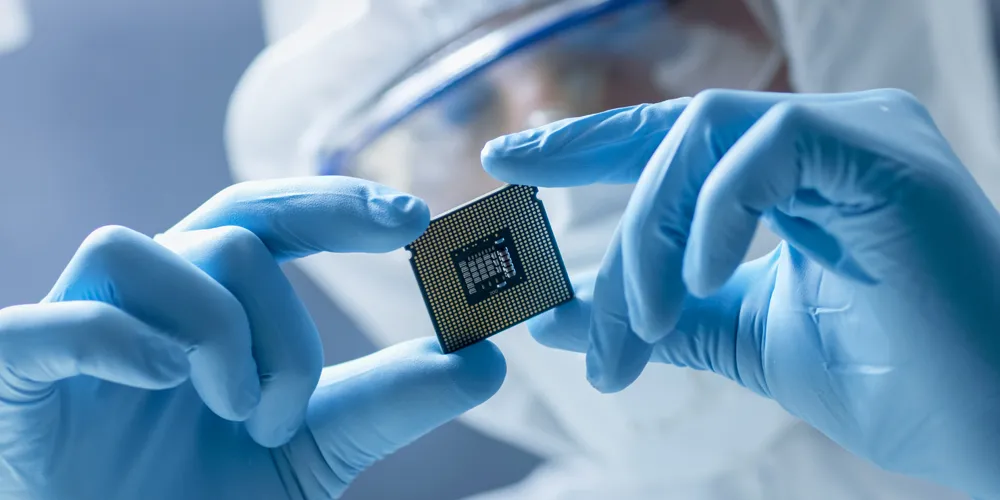
Investment in domestic production is accelerating, particularly in the semiconductor sector. TSMC's first plant in Kumamoto (JASM) began mass production at the end of 2024. Construction on its second plant began in October 2025. Combined investment across the two plants is expected to reach about 3 trillion yen. Employment is projected to exceed 3,400.
Meanwhile, Rapidus plans to begin mass production of 2nm semiconductors in Chitose, Hokkaido, in the second half of fiscal 2027. Cumulative investment is expected to exceed 7 trillion yen.
The government’s "AI and Semiconductor Industry Foundation Strengthening Framework," released in November 2024, outlines a policy of providing more than 10 trillion yen in public support by fiscal 2030. The goal is to attract over 50 trillion yen in combined public and private investment over ten years.
If this support is effectively utilized and domestic industrial concentration advances, a positive cycle is expected to emerge, in which job creation, stable labor supply, and economic security are strengthened simultaneously.
Sources:
Ministry of Economy, Trade and Industry, "AI and Semiconductor Industry Foundation Strengthening Framework," November 2024; Japanese Only
Nikkei, "Government to Add 1 Trillion Yen to Rapidus Support, Bringing Cumulative Total to 2.9 Trillion Yen," November 2025; Japanese Only
What is required of Japanese manufacturing to secure this future
To realize its potential, Japanese manufacturing faces two hurdles:
- Integrating analog and digital worlds
- Producing a stable supply of high-value-added products
Integrating Analog and Digital Worlds
Japanese companies produce more than 220 items that hold over 60% share of the global market. At the same time, only three of the 223 sites selected worldwide for the World Economic Forum's "Global Lighthouse Network" (recognizing the world's most advanced factories) are located in Japan. Digital transformation at the factory level remains a work in progress.
This does not mean that craftmanship needs to be abandoned. Instead, these skills must be integrated with digital technology. Combining accumulated analog expertise with digital technology creates a core of competitive strength that other countries will find difficult to imitate.
Sources:
NEDO, "Innovation Through New Materials Opening the Frontier of Industrial Technology," Japanese Only
Ministry of Economy, Trade and Industry, "2023 White Paper on Manufacturing"; Japanese Only
World Economic Forum, "Global Lighthouse Network,"
Producing a Stable Supply of High-Value-Added Products
The global semiconductor shortage in 2020-2022 exposed a major risk for manufacturers: When particular components or materials become unavailable, entire supply chains can grind to a halt. Global manufacturing has since come to realize that reliable supply is more important than low cost.
Japan produces many items whose high value-added allows them to command more than half of global market share. Developing and maintaining systems that can reliably deliver these high-value-added products are necessary for Japanese manufacturing to remain an essential part of the global supply chain.
Sources:
Nikkei, "Murata Manufacturing Develops World's Smallest Multilayer Ceramic Capacitor," September 2024; Japanese Only
Yano Research Institute, "2024 Outlook and Strategy for PAN-Based Carbon Fiber and Composite Materials Markets" October 2024; Japanese Only
Orbray's Initiatives that Embody What Is Required of Japanese Manufacturing
Orbray is advancing the following three initiatives that reflect what is required of Japanese manufacturing to meet the future:
- Applying analog ultraprecision machining technology to digital fields
- Extending technology into next-generation domains
- Consolidating production sites and co-creating with the local community
Applying Analog Ultraprecision Machining Technology to Digital Fields
Orbray is extending the ultraprecision machining technology cultivated through cutting, grinding, and polishing into fields such as optical communications and silicon photonics.
Realizing the high-speed, high-capacity communications that support a digital society requires precision machining and connection technologies that transmit light accurately and with low loss. One example is edge-face polishing of silicon photonics chips. Orbray designs proprietary fixtures matched to the size of each substrate, and processes optical substrates including silicon and lithium niobate.
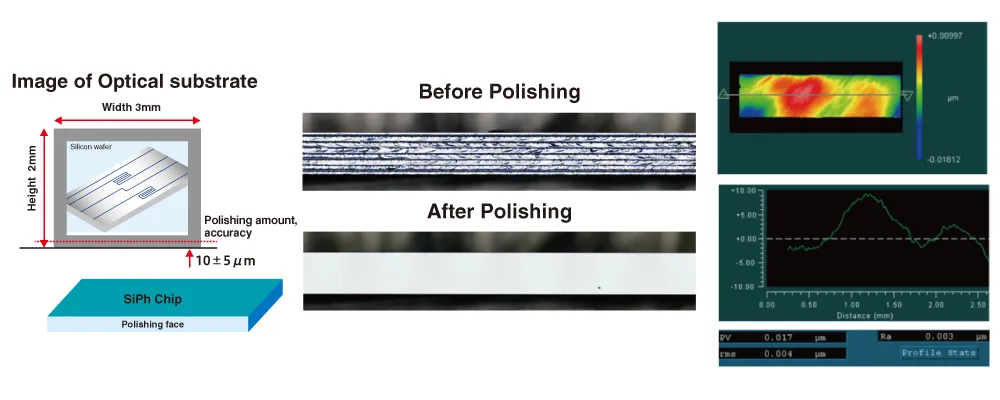
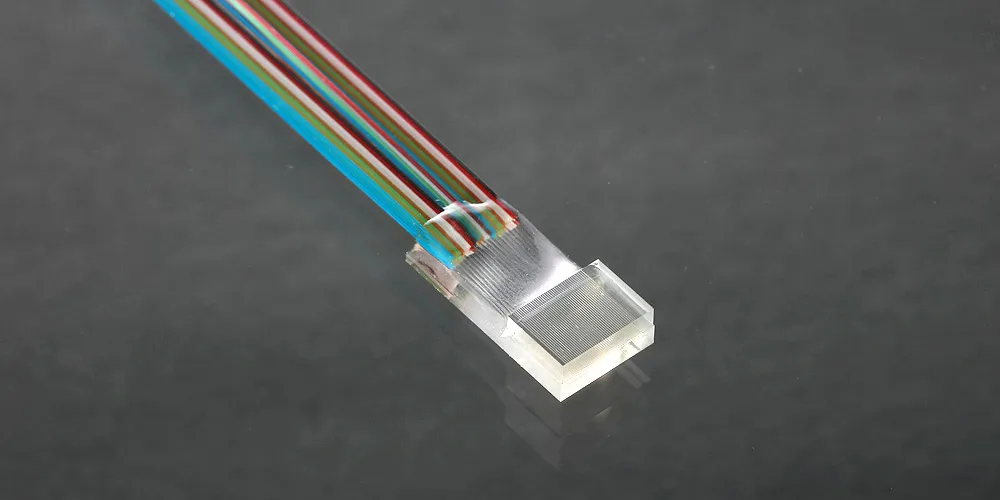
These machining techniques are also applied to fiber arrays, which precisely align multiple optical fibers. Optical fibers are secured to ultraprecision-machined components such as V-groove substrates. The end faces are then polished to sub-micron flatness, enabling high-precision, low-loss connections between optical waveguides and optical fibers. In this way, Orbray is developing its analog machining expertise into high-value-added products that support the foundations of the digital era.
Sources:
Orbray, "End-Face Polishing of Si Photonics Chips,"
Orbray, "Fiber Arrays,"
Extending Technology into Next-Generation Domains
Orbray has applied its proprietary Step-Flow Growth Method used in sapphire substrate crystal growth to diamond. By growing diamond laterally on a sapphire substrate, the company has established the world's first mass production technology for large-diameter, 2-inch diamond wafers.
In June 2024, Orbray concluded a strategic partnership with Element Six, a subsidiary of De Beers of the UK. By combining the technologies of both companies, the partnership aims to achieve mass production of wafer-scale single-crystal diamond. Mass production of 2-inch diamond substrates is scheduled to begin in 2027. Mass production technology for 3-inch substrates has also been established, and development of 4-inch substrates is now underway.
Application areas are expanding into fields at the core of next-generation industries. These include power semiconductors for EVs, high-frequency devices for 6G communications, and quantum memory for quantum computers.
The accumulated analog technology of cutting, grinding, and polishing is producing the foundational materials for next-generation industries.
Sources:
Orbray, "Orbray and Element Six Partner in World-Leading Large-Diameter Single-Crystal Synthetic Diamond Business," June 10, 2024, press release
Orbray, "Element Six and Orbray accelerate wafer-scale single crystal diamond for volume production," June 16, 2026, press release
Consolidating Production Sites and Co-Creating with the Local Community
Orbray is working to move its headquarters to Yuzawa City, Akita Prefecture. Official registration of the new address is slated for the end of 2026. Since establishing operations there in 1967 as Yuzawa's first officially invited company, Orbray has built a relationship with the region spanning nearly 60 years.
In August 2023, the new "OrbrayTRAD" plant began operations in Iwasaki, Yuzawa City, taking over production of record styli and watch exterior components.
For talent development, the internal training program "Orbray Academy" operates at three colleges. New graduate hiring in 2026 exceeded 60, with the majority recruited from the Tohoku region, including Akita and Aomori.
Through co-creation with the local community, Orbray embodies a positive cycle of job creation and stable labor supply.
Source:
Orbray, "Building New HQ; Upgrading Mid-Term Plan" October 22, 2025, press release
Conclusion: Through Digitalization and High Value-Added, Japan Is Positioned to Deliver to the World.
Against the backdrop of US-China trade tensions and rising geopolitical risks, Japanese manufacturing is being reassessed as a difficult-to-substitute supply source. To fulfill this potential, reshoring and consolidation of production sites are advancing.
To remain competitive in the future, Japanese manufacturing needs to combine long-accumulated analog strengths with digital technology, and to reliably deliver high-value-added products. Japanese manufacturers are positioning themselves away from price competition and toward supply chain dominance through technology.
Through the advancement of ultraprecision machining technology, the extension of technology into next-generation domains, and domestic industrial concentration built together with the local community, Orbray is already demonstrating the future of Japanese manufacturing.