
What Is a Brushless DC Motor(BLDC motors)? Understanding Its Structure, Operating Principle, and Applications
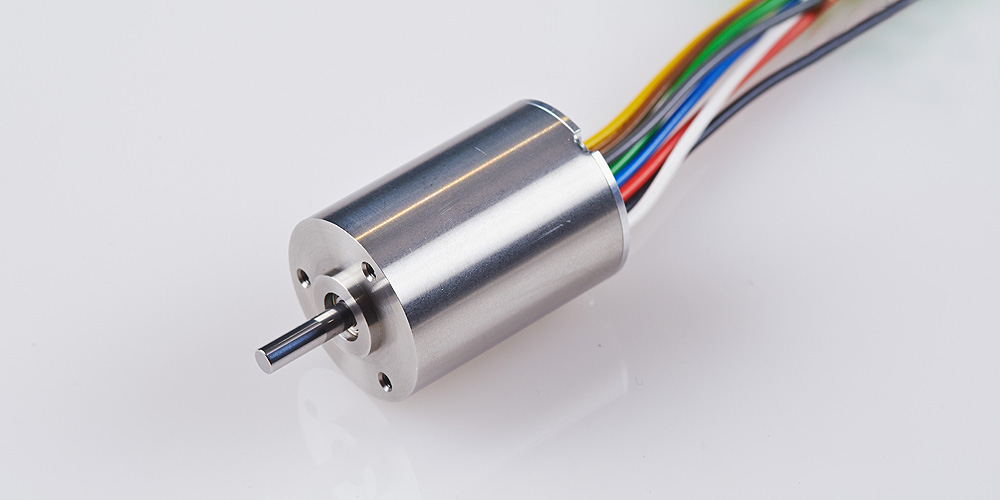
Brushless DC motors (BLDC motors) are widely used in products that support our daily lives, including industrial robots, medical devices, drones, and cameras.
Known for their long service life, high efficiency, and precise controllability, brushless DC motors have become increasingly popular across a wide range of industries. However, many people are less familiar with how these motors are constructed and how they generate rotational motion.
This article explains the basic structure, operating principles, and key characteristics of brushless DC motors in an easy-to-understand way.
Table of contents [close]
What Is a Brushless DC Motor?
A brushless DC motors is a DC motor that operates without brushes.
Unlike a brushed DC motor, it eliminates the brushes that supply current to the coils and the commutator that switches the direction of current flow. Instead, current is controlled electronically, removing the need for mechanical electrical contacts.
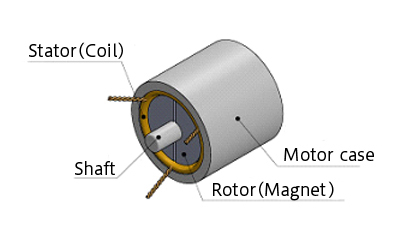
The basic structure of a brushless DC motor consists of a stator containing coils (windings) and a rotor equipped with permanent magnets. Compared with a brushed DC motor, the functions of the stator and rotor are essentially reversed, with the coils and magnets exchanging positions.
To drive a brushless DC motor with the appropriate timing, the controller must detect the position of the rotor's permanent magnets. Two primary methods are used for this purpose.
One method uses sensors, such as Hall-effect ICs, to directly detect the position of the permanent magnets.
The other is a sensorless approach that does not require physical position sensors. As the rotor rotates, a small voltage is induced in the coils that are not currently energized. By monitoring changes in this voltage, the control circuit can estimate the rotor position without dedicated sensors.
Because there are no brushes to wear out, brushless motors offer a long operating life, efficient energy conversion, and highly precise speed control. However, unlike brushed motors, they cannot operate simply by connecting a DC power supply. A dedicated drive circuit is required to switch the current electronically, which adds complexity to the system.
Basic Structure of a Brushless DC Motor
Brushless DC motors can be broadly classified into two types according to the arrangement of the rotor and stator:
- Inner-rotor type
- Outer-rotor type
The inner rotor type features a structure where the rotor is placed inside and the stator outside.
Because the rotor diameter is relatively small, it has a low moment of inertia, enabling fast response and high-speed operation. This design is commonly used in applications that require rapid acceleration and high rotational speeds.
The outer rotor type features a structure where the rotor is placed outside and the stator inside. Because the rotor has a larger radius of rotation, it is well-suited for generating large torque. Its rotation tends to be stable, and since fan blades can be attached directly to the outer shell, it is widely used in fans and similar applications.
Magnet Arrangements in Brushless DC Motors
Permanent magnets can be mounted in two primary ways:
- Surface Permanent Magnet (SPM)
- Interior Permanent Magnet (IPM)
SPM motors have magnets attached directly to the rotor surface.
This design is relatively simple and easy to control. However, special measures must be taken to prevent magnets from detaching due to centrifugal force during high-speed operation.
IPM motors have magnets embedded inside the rotor.
In addition to magnetic torque generated by the permanent magnets, these motors can utilize reluctance torque, which results from variations in magnetic reluctance within the rotor. This enables high efficiency and high output, making IPM motors suitable for demanding applications.
Orbray's brushless motors employ a structure similar to an SPM design. However, Rather than attaching magnets to a laminated iron core, the cylindrical magnet itself serves as the rotor body, creating a unique and compact motor structure.
View Orbray's Brushless Motors
Position Sensors Used in Brushless DC Motors
Several types of position sensors are commonly used in brushless DC motor systems:
- Hall-effect ICs
- Resolvers
- Rotary encoders
- Potentiometers
Hall-effect ICs detect changes in magnetic fields to determine rotor position.
They are compact, inexpensive, contactless, and highly durable.
Resolvers use electromagnetic induction to measure rotor angle.
Because they are resistant to heat, vibration, and oil contamination, they are often selected for harsh operating environments.
Rotary encoders output electrical signals corresponding to rotational movement, angle, or position. They are available in incremental versions, which measure relative movement, and absolute versions, which provide exact position information.
Potentiometers generate an output voltage proportional to rotational angle.
While simple and cost-effective, they rely on sliding contacts that wear over time and have a limited measurement range. As a result, they are commonly used in applications with restricted rotational movement, such as robotic joints and valve-position control systems.
How Does a Brushless DC Motor Rotate?
-
Step 1U+ and V−
Magnetic field points upward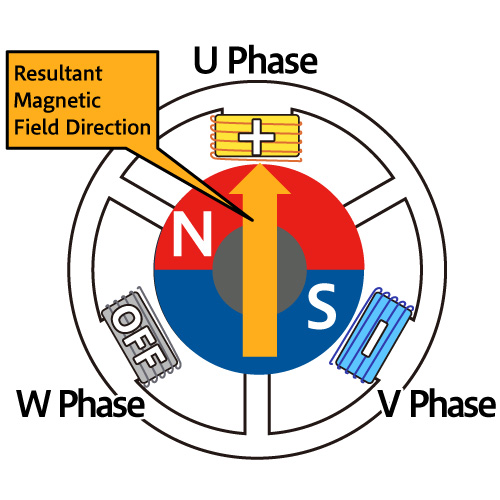
-
Step 2V+ and W−
The magnetic field rotates by 120°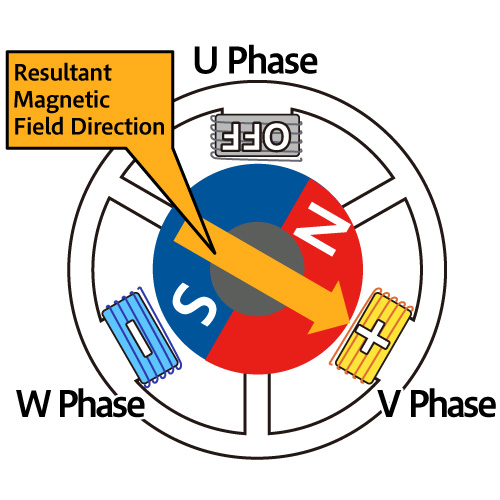
-
Step 3W+ and U−
The magnetic field rotates a further 120°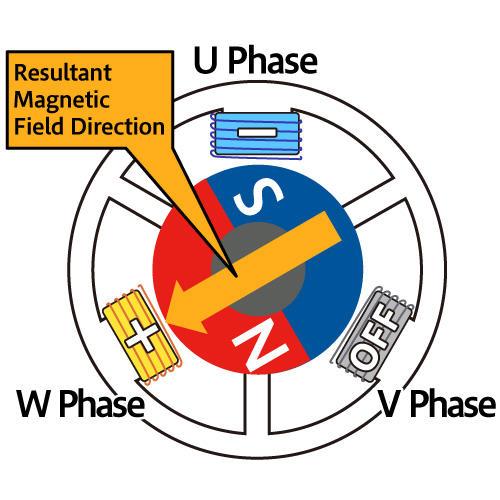
-
Step 4Returns to the U+ and V− phase combination, and the cycle repeats.
A brushless DC motor rotates through the following process:
- Current is sequentially supplied to the three stator windings (U phase, V phase, and W phase).
- The magnetic field generated by the windings changes direction continuously, creating a rotating magnetic field.
- The rotor's permanent magnets follow this rotating field, producing rotational motion.
The key to smooth operation is the timing of current switching.
Using either position sensors or sensorless control technology, the controller continuously monitors rotor position and energizes the appropriate windings. This electronic commutation enables smooth and efficient rotation.
In a brushed motor, the commutator and brushes mechanically switch the current. In contrast, brushless motors perform this switching electronically.
Two common drive methods are used:
- 120-degree commutation (trapezoidal drive), where two phases are energized at a time
- Sinusoidal drive, where current changes smoothly following a sine wave
Sinusoidal drive generally produces lower vibration and noise than trapezoidal drive.
Key Features of Brushless DC Motors
The major advantages of brushless DC motors can be summarized in three areas:
- Long service life with reduced maintenance
- High efficiency and high-speed capability
- Precise speed control
Long Service Life With Reduced Maintenance
Brushless DC motors do not contain brushes or commutators, which are components subject to wear. As a result, periodic brush replacement is unnecessary. In most cases, bearing life becomes the primary factor determining motor longevity.
Compared with brushed motors, brushless motors offer significantly longer service life and lower maintenance requirements, making them well suited for continuous-duty equipment and applications where maintenance access is difficult.
High Efficiency and High-Speed Operation
Brushless DC motors provide excellent energy conversion efficiency.
In brushed motors, friction between the brushes and commutator continuously generates heat and energy loss. Because brushless motors eliminate these mechanical contact points, more electrical energy can be converted into useful rotational power.
The absence of friction also contributes to stable high-speed operation.
Reduced wear and heat generation allow the motor to maintain performance even at elevated rotational speeds.
In addition, designs in which the windings are fixed in close contact with the motor housing can dissipate heat more efficiently. This improved heat dissipation allows larger currents to be applied, making high-power motor designs possible.
Precise Speed Control
Brushless DC motors are known for their ability to maintain speed accurately and consistently.
In brushed motors, brush wear gradually changes electrical contact conditions, which can lead to shifts in operating characteristics over time.
Since brushless motors have no mechanical electrical contacts, such performance variations are minimized, allowing stable speed control over extended periods.
The absence of brush-related arcing and contact bounce also enables stable operation at higher rotational speeds.
Orbray's brushless motors utilize a slotless stator structure, which eliminates slots in the magnetic core. This design prevents cogging torque, a source of rotational irregularity caused by magnetic attraction between the rotor and stator core. As a result, smooth rotation is maintained even at low speeds.
These characteristics make Orbray's motors particularly suitable for applications requiring quiet operation and highly stable motion, such as medical devices and robotic systems.
Conclusion: Brushless DC Motors Deliver Long Life and High Efficiency
The primary advantages of brushless DC motors are their long service life, high efficiency, and precise speed control.
Because they do not rely on wear-prone electrical contacts, they offer excellent durability while achieving efficient operation and high rotational speeds.
Orbray's brushless motors further enhance these advantages through proprietary technologies. Using self-developed winding equipment, Orbray achieves high-density coreless windings that improve torque constants while reducing current consumption.
In addition, our B4S Series employs a four-pole magnet configuration instead of a conventional two-pole design, increasing the effective magnetic flux area and achieving higher torque output.
Orbray also offers standard brushless motors with an outer diameter of just 4 mm, a size that only a handful of companies worldwide can mass-produce. These motors are used in applications such as portable medical devices, where exceptional performance is required within extremely limited space.
If you are considering a brushless motor for your application, please feel free to contact us for consultation.