How Fiber Optic Lighting Works: Benefits, Applications, and LDF Lighting Fiber
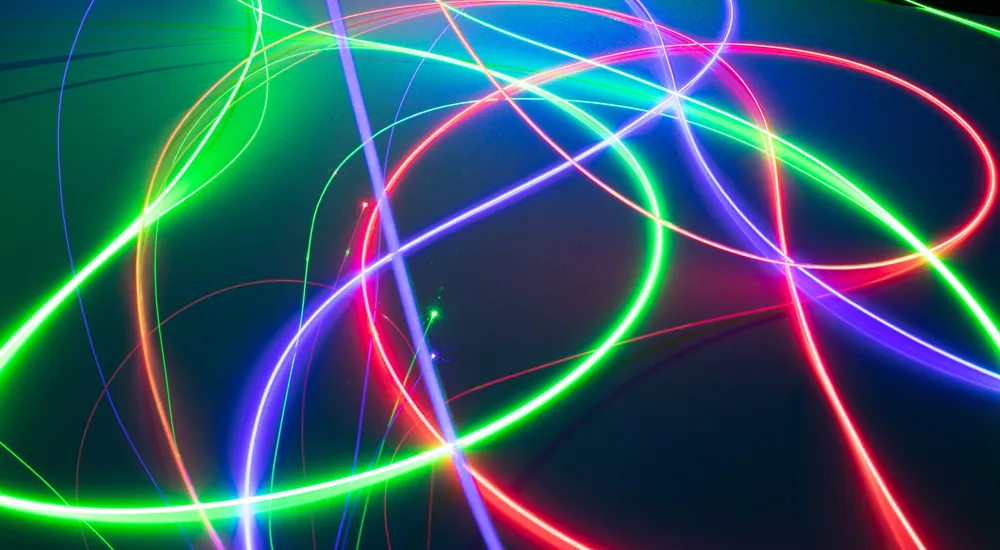
Fiber optic lighting carries light from a source through thin fibers to illuminate distant or confined spaces. No heat or electricity reaches the illumination point. The thin, flexible fibers can be routed freely. Due to these benefits, fiber optic lighting is widely used in retail and facility interiors, stage and event production, and automotive interiors.
Fiber optic lighting works very differently from conventional lighting. Therefore, it is essential to understand both their strengths and limitations when considering their use.
This article explains how fiber optic lighting works, light sources, advantages, and key considerations for adoption. It also introduces Orbray's LDF lighting fiber, which emits light as a continuous line. They can be used in a wide range of settings, such as concerts, exhibitions, and automotive decoration.
Table of contents [close]
What Is Fiber Optic Lighting?
Fiber optic lighting transmits light from a source such as an LED or laser through optical fibers, causing the fiber tips or sides to glow.
What sets optical fibers apart from conventional lighting is that they carry only light. No bulbs or fixtures are needed at the illumination point. Because the fibers themselves do not emit light, they are always used together with a light source.
How Fiber Optic Lighting Works
Fiber optic lighting carries light by reflecting it along the inside of the fibers until it is released at the end.
Optical fibers have a two-layer structure: a core with a high refractive index, surrounded by cladding with a lower refractive index. Light entering the core undergoes repeated total internal reflection at the boundary with the cladding. This is what allows light to travel long distances, even along curved paths.
On the other hand, some fibers are designed to allow some light to escape the sides as it travels. This results in fibers that glow along their sides. The most common materials are plastics such as acrylic resin (PMMA) and silica glass.
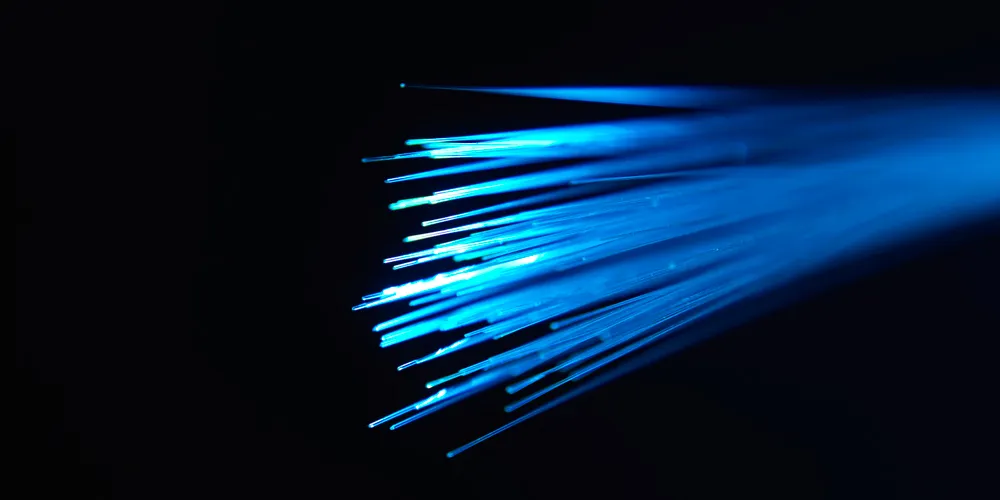
End-Emitting vs. Side-Emitting Fibers
Fiber optic lighting can be divided into two types by how the light is emitted: end-emitting, in which the fiber
tips glow, and side-emitting, in which the fibers glow along their entire length.
End-emitting fibers, also called end light, produce a point of light at their tips. They are used for spot lighting and to create star-effect ceilings, in which multiple fibers embedded overhead recreate a night sky.
Side-emitting fibers, also called side light, emit light along their length. They are well suited for outlining and linear lighting and can be used for highly decorative designs.
Light Sources Used in Fiber Optic Lighting
The three main light sources used in fiber optic lighting are LEDs, lasers, and sunlight.
LEDs are currently the mainstream light source. Special LED light sources concentrate the light and feed it into the end face of the fiber. Their main advantage over sources such as halogen lamps is a longer service life.
Lasers produce a tightly focused beam. They deliver light efficiently even into thin fibers.
Sunlight is used in daylighting systems. These systems collect outdoor light and carry it indoors through optical fibers. This allows rooms without windows to be illuminated with sunlight.
Three Distinct Advantages of Fiber Optic Lighting
Fiber optic lighting offers three advantages over conventional lighting equipment.
- No heat or electricity at the illumination point
- Thin and flexible enough for confined spaces and curved surfaces
- Centralized light sources for easier maintenance
No Heat or Electricity at the Illumination Point
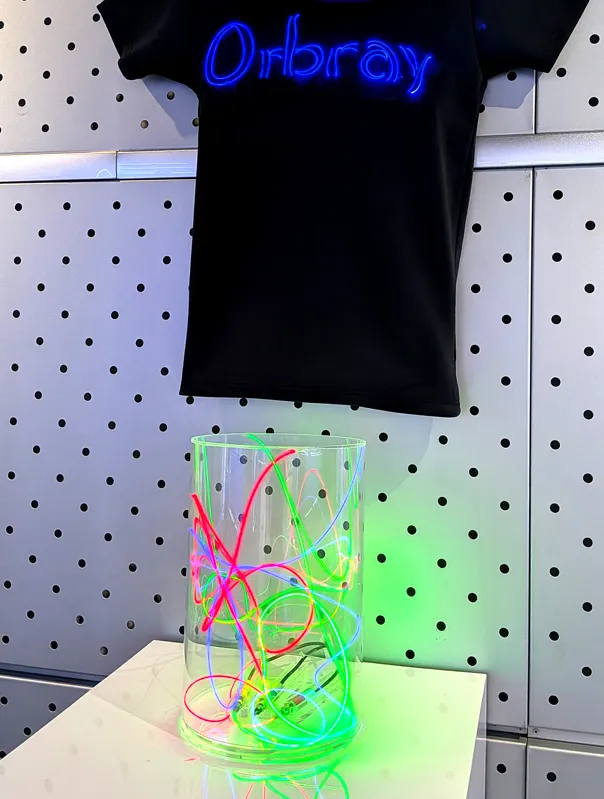
A key advantage of fiber optic lighting is that no heat or electricity reaches the illumination point.
The fibers carry only light, so there is no wiring or heat source at the illumination point. With little risk of electric shock or current leakage, they can be used underwater and in humid environments such as fountains and bathing facilities.
Plastic optical fibers also transmit very little ultraviolet or infrared light, making them well suited to display lighting for artwork that is sensitive to heat and light.
Thin and Flexible Enough for Confined Spaces and Curved Surfaces
Optical fibers are thin and flexible. Therefore, they can be installed in confined spaces and on curved surfaces where large light fixtures cannot be installed.
Conventional fixtures require space for the housing and wiring. Optical fibers, by contrast, can be routed through narrow gaps in furniture and walls and along complex shapes.
Because the light is visible while the equipment is not, fiber optic lighting integrates readily into architecture, interiors, and product design.
Centralized Light Sources for Easier Maintenance
Light source units can be installed together in a single location, which simplifies maintenance.
The light source unit can be placed where it is easy to service, with the fibers carrying light to high or hard-to-reach positions. Replacement and inspection are carried out at the light source unit alone, without any need to access illumination points in ceilings or underwater.
Distributing light from a single source across multiple fibers allows several illumination points to be controlled together. With laser sources, however, light is coupled in as a narrow beam, so splitting it results in uneven brightness between fibers.
Two Considerations When Adopting Fiber Optic Lighting
Two factors require attention when adopting fiber optic lighting: light attenuation and bending limits.
- Longer the fiber, the weaker the light becomes
- Excessive bending causes damage and light leakage
Light Weakens over Longer Fiber Runs
The longer the fibers, the weaker the light is at their far ends. Light is lost gradually as it travels along the fibers. In plastic lighting fibers, attenuation (light loss) is approximately 4 to 5% per meter. Side-emitting fibers release light along their length, so their far ends are particularly prone to dimming.
Countermeasures include selecting a length suited to the application, feeding light in from both ends, and adding light sources.
Excessive Bending Causes Damage and Light Leakage
Bending optical fibers beyond their allowable range can cause damage and light leakage.
Each fiber has a specified minimum bend radius, which defines how tightly it can be bent. Beyond that limit, light is no longer fully reflected at the boundary between the core and cladding. It leaks out, and brightness drops. Glass fibers can also break, so they require particular care.
Orbray's LDF Lighting Fiber
Orbray's LDF (Light-Diffusing Fiber) is a lighting fiber that emits light uniformly along its entire length. Orbray processes the fiber ends and fits the connectors, so the fiber is ready to use once connected to a light source.
- A uniform line of light from a single thin fiber
- A wide range of colors and gradients with laser sources
- Suitable for bending and underwater use
A Uniform Line of Light from a Single Thin Fiber
One major advantage of LDFs is that a single thin LDF fiber produces an even, continuous line of light.
Fine scattering structures built into the glass fiber radiate incoming light uniformly through its sides. With an outer diameter of just 900 μm including the PVC tube, LDF can be incorporated into spaces too narrow for conventional lighting equipment.
A Wide Range of Colors and Gradients with Laser Sources
Combined with a laser source, LDF can display a wide range of colors and gradients. With an RGB multi-color laser module, red, green, and blue can each be adjusted in 128 steps, reproducing virtually any color. Feeding a different color into each end of the fiber blends the two toward the center. Blue and red, for example, produce a gradient that turns purple at the midpoint.
LDF also supports higher brightness through input from multiple light sources, and partial illumination when combined with transmission fiber, further expanding the range of possible effects.
Suitable for Bending and Underwater Use
LDF can be bent and used underwater, allowing considerable freedom in installation locations. With a bend radius down to 10 mm, it can follow curves, lettering, and logos.
Because no electricity passes through the fiber, it can be used underwater without risk of electric shock. The properties of laser light also make the line appear to float in water, an effect suited to aquariums, fountains, and other water features.
LDF Lighting Fiber: Application Examples
Orbray's LDF has been used in concerts, exhibitions, automotive decoration, and other settings where lighting is used for visual effect.
- Concert venue illumination
- An exhibition booth synchronizing light with music
- Interior and exterior decoration for an electric vehicle
Case 1: Concert Staging Combining Lines of Light and Projection Mapping
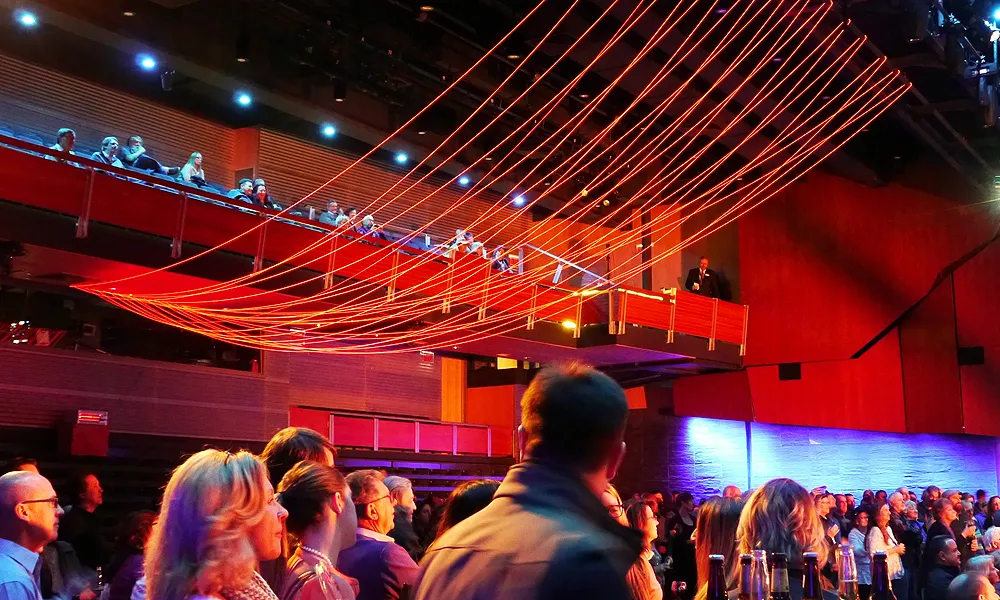
Orbray's LDF was used for illumination at a concert venue, where it was combined with projection mapping to depict waves.
Projection mapping is a technique that projects video onto three-dimensional objects such as buildings and stage sets, making them appear to move or change.
Because the entire fiber emits light evenly and can be shaped freely down to a 10 mm bend radius, LDF can reproduce the curves of rolling waves as lines of light. Color and brightness can also be finely adjusted to match the tone and flow of the projected video.
In a darkened venue, even a thin line of light stands out clearly. Overlaying lines of light on the projected video adds a sense of depth that flat projection alone cannot easily achieve. Because no electricity passes through the fiber, it is also easy to integrate into stage equipment.
Case 2: An Exhibition Booth Synchronizing Light with a DJ Mixer
At an exhibition, LDF was used in a booth to synchronize lighting with music played through a DJ mixer. At exhibitions with many booths side by side, features that are visible from a distance are essential for grabbing the attention of visitors. Lighting that changes with the music attracts attention through movement, making it an effective way to raise interest in a booth.
The LDF light source module varies color and brightness finely through PWM control, a method that adjusts brightness by the on/off ratio of an electrical signal. This allows the lighting to follow the rhythm and progression of the music.
With limited time for setup and teardown at exhibitions, ease of preparation is also important. LDF is supplied with connectors already fitted, so it lights up as soon as it is connected to a light source. When off, it is transparent and unobtrusive, and the contrast with its lit state heightens the impact of the lighting.
Case 3: Decorative Lighting for an Electric Vehicle at an International Event
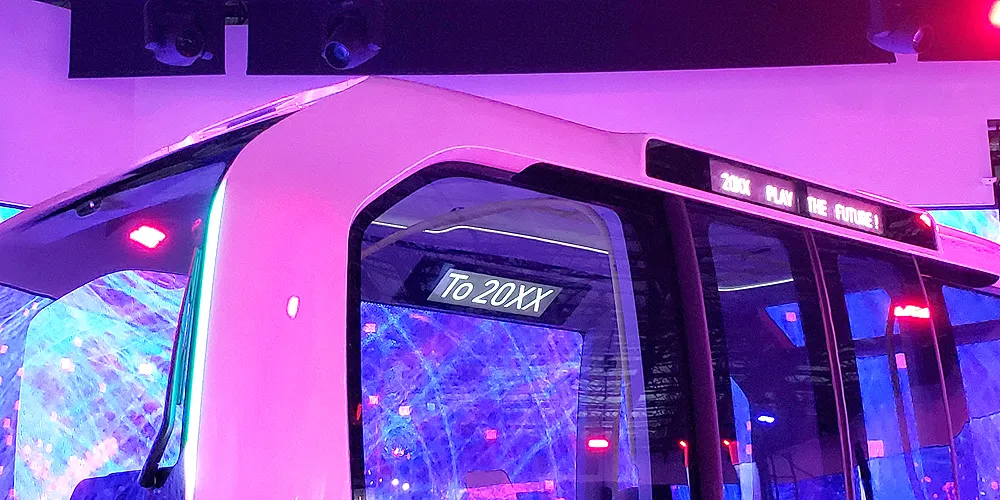
LDF was used to decorate the interior ceiling and running board areas of an electric vehicle exhibited at an international event. A vehicle's ceiling and running boards offer little space for mounting light fixtures. At just 0.9 mm in diameter, LDF fits into narrow gaps between interior panels and traces lines of light along the contours of the ceiling and running boards. With no heat or electricity at the illumination point, it can also be placed within easy reach of passengers' hands and feet.
LDF has also been used for concept car exteriors and tail lamps, and for exterior lighting on vehicles shown at in-house previews. For vehicles intended to showcase their design, the ability to display light without visible fixtures is a significant advantage. Inconspicuous when off and accentuating the body lines when on, LDF is increasingly used as decorative lighting that enhances automotive design.
LDF has also been used in a wide range of other applications, including:
- Corporate entrance displays
- Pictograms inside amusement park tunnels
- Indirect lighting in car showrooms
- Exterior lighting for pachinko parlors
- Theater company props
- Indirect lighting for store opening celebrations
- Trackside lighting on model railway dioramas
LDF can be ordered in quantities as small as one unit. It is available in three light-diffusion lengths (1m, 5m, and 10m), and connects to the light source with an FC connector.
Lead times vary with quantity, with delivery typically possible within a few weeks to two months. Because the optimal configuration depends on the application and quantity, Orbray welcomes inquiries at any stage.
Detailed LDF specifications and the light source module lineup are available on the product page below.
Summary: Lighting Design Freed from the Constraints of Heat or Electricity
Fiber optic lighting carries light from a source through optical fibers and emits it from their tips or sides. No heat or electricity reaches the illumination point, and the fibers can be installed in confined spaces and on curved surfaces. However, it is important to account for light attenuation and bending limits in the design.
Orbray's LDF produces a uniform line of light from a single fiber. When combined with a laser source, a wide range of colors can be displayed. It is well suited to concerts, exhibitions, automotive decoration, and other settings where light is used to shape a space.
Product details are available on the LDF product page below.